


Gemological Glossary
A clear and rigorous glossary to better understand stones, diamonds, cuts, treatments, and the main terms encountered in jewelry.
Maison Miller
233 rue Saint-Honoré - 75001 Paris
| A | B | C | D | E | F | G | H |
| I | J | K | L | M | N | O | P |
| Q | R | S | T | V | Z |

A
4Cs: the four international criteria used to describe the quality of a diamond: Carat (weight), Color, Clarity, and Cut.
Abrasion: surface wear visible as very fine marks or scratches, particularly along the facet edges of a stone.
Adamantine: A very intense luster characteristic of diamonds and a few other gemstones with a high refractive index.
Adularescence: a floating luminous reflection, often bluish or whitish, characteristic of certain moonstones.
Agate: a variety of chalcedony, generally banded or zoned, used since antiquity in jewelry, decorative art objects, and for cameos.
Aquamarine: a blue to blue-green variety of beryl. Its color is mainly linked to the presence of iron.
Alexandrite: a rare variety of chrysoberyl known for its color change depending on the lighting, typically from green to red or purplish-red.
Amber: an organic gemstone material derived from fossilized plant resin, typically ranging in color from light yellow to orange-brown.
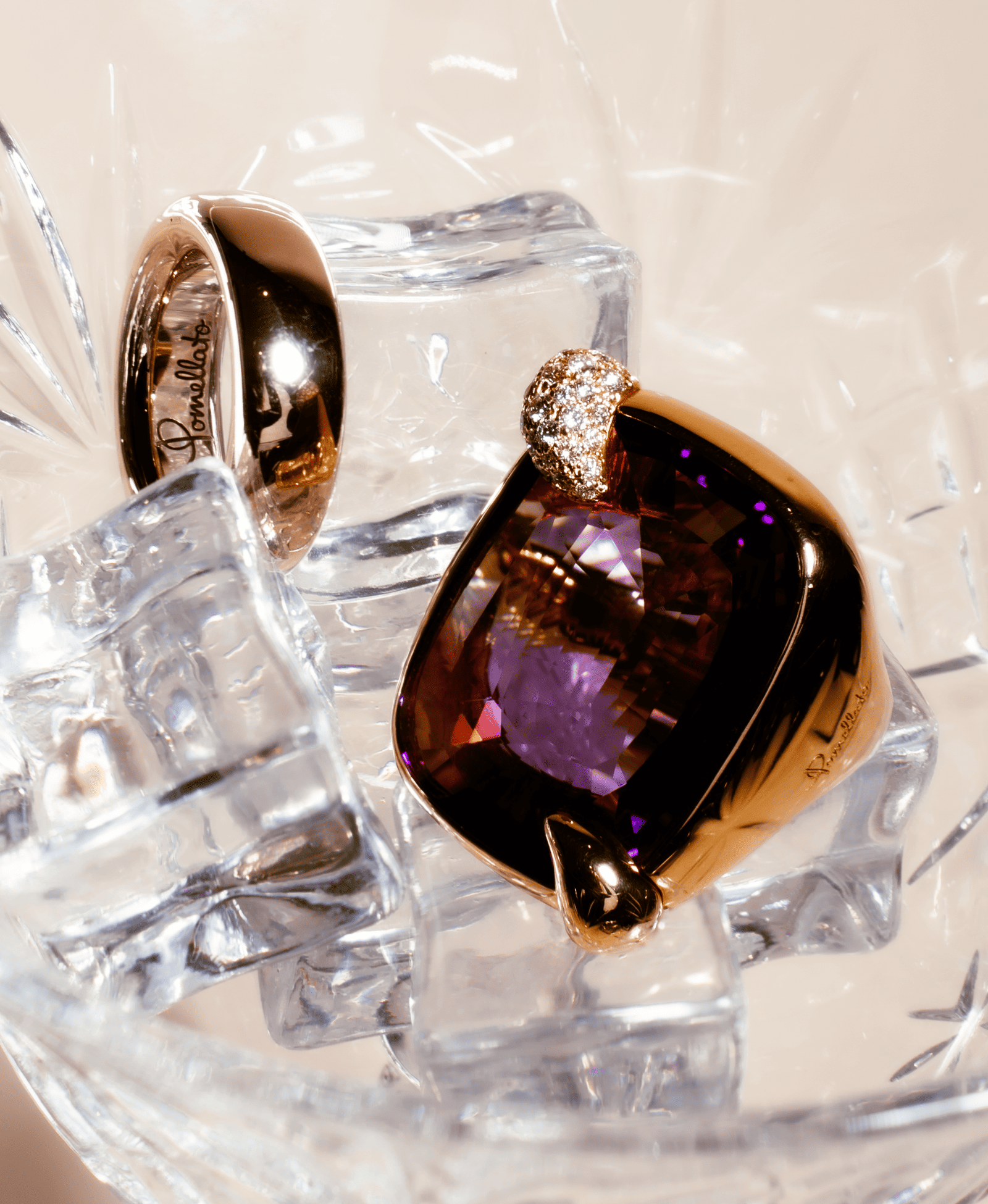
Amethyst: a purple variety of quartz, prized in jewelry for its color ranging from pale lilac to deep violet.
Asterism: an optical phenomenon producing a luminous star on the surface of certain cabochon-cut gemstones, such as some rubies and sapphires.
B
Baguette (cut): a step cut, rectangular and elongated, widely used for accent diamonds and geometric compositions.
Beryl: a mineral family including, among others, emerald, aquamarine, and morganite.
Birefringence: an optical property of certain anisotropic gemstones in which light travels in two directions at different speeds.
Brilliance: the amount of white light returned to the eye by a cut gemstone. It depends notably on the proportions, symmetry, and polish.
Brilliant (cut): a style of cut designed to optimize light return. The round brilliant diamond cut typically features 57 or 58 facets.
Briolette (cut): an antique or fancy cut in the shape of a drop, faceted over a large part or all of its surface, often used as a pendant.
Rough (brut): a stone or crystal in its natural state, before cutting and polishing.
C
Cabochon: a cut without facets, featuring a smooth, domed surface. It is notably used for opals, turquoises, and gemstones with optical effects.
Cameo: a motif carved in relief into a material that often presents several layers of color, such as agate or shell.
Carat (ct): a unit of mass for gemstones. One carat equals exactly 0.20 grams. Not to be confused with the karat used for gold purity.
Gemological certificate: a document issued by a laboratory describing the characteristics of a stone. For a diamond, it may specify weight, color, clarity, and cut. It does not constitute a financial appraisal on its own.
Chalcedony: a family of microcrystalline quartz including agate, onyx, and jasper.
Chatoyancy: an optical effect in the form of a mobile line of light reminiscent of a cat's eye, visible on certain cabochon-cut gemstones.
Citrine: a variety of quartz with a color ranging from yellow to orange-yellow or brownish.
Cleavage: the tendency of a crystal to break along certain planes of its structure. Diamond has perfect cleavage despite its extreme hardness.
Coral: an organic gemstone material derived from the calcareous skeleton of certain marine organisms. Its trade is subject to regulations depending on the species and origins.
Corundum: a mineral species whose most famous gem varieties are ruby and sapphire.
Diamond color: for colorless to slightly tinted diamonds, the GIA uses a scale ranging from D (colorless) to Z (more pronounced yellow or brown tint). Intense colored diamonds fall under a distinct classification called Fancy Color.
Crown: the upper part of a faceted stone, located between the girdle and the table.
Cushion (cut): a square or rectangular shape with rounded corners, available in many proportions and faceting styles.
D
Diamond: a carbon crystal formed naturally under very high pressure and temperature conditions. It reaches 10 on the Mohs scale and possesses exceptional optical properties.
Fancy color diamond: a diamond whose natural color has sufficient intensity to be classified according to a specific scale. Colors can be yellow, pink, blue, green, or brown, among others.
Lab-grown diamond: a diamond created by a technological process, generally HPHT or CVD, possessing essentially the same chemical composition and crystal structure as a natural diamond. Its origin must be clearly declared.
Natural diamond: a diamond formed in nature, primarily in the Earth's mantle, and brought to the surface by geological processes.
Dispersion: the separation of white light into spectral colors as it passes through a gemstone. In a diamond, it contributes to the phenomenon called fire.
Doublet: an assembled stone consisting of two elements joined together, sometimes to imitate or improve the appearance of a gemstone.
Hardness: a mineral's resistance to scratching. It is commonly expressed on the Mohs scale.
E
Chip: a small fragment or loss of material caused by an impact, often located on the girdle, an edge, or a culet.
Mohs scale: A comparative scale of hardness ranging from 1 for talc to 10 for diamond.
Luster: the way a gemstone's surface reflects light, such as adamantine, vitreous, pearly, silky, resinous, etc.
Emerald: a green variety of beryl, colored primarily by chromium and/or vanadium. Inclusions are frequent and are natural characteristics often observed in this gem.
Colombian emerald: an expression designating an emerald whose Colombian geographical origin has been determined. Origin may influence market perception but is never sufficient, on its own, to determine quality or value.
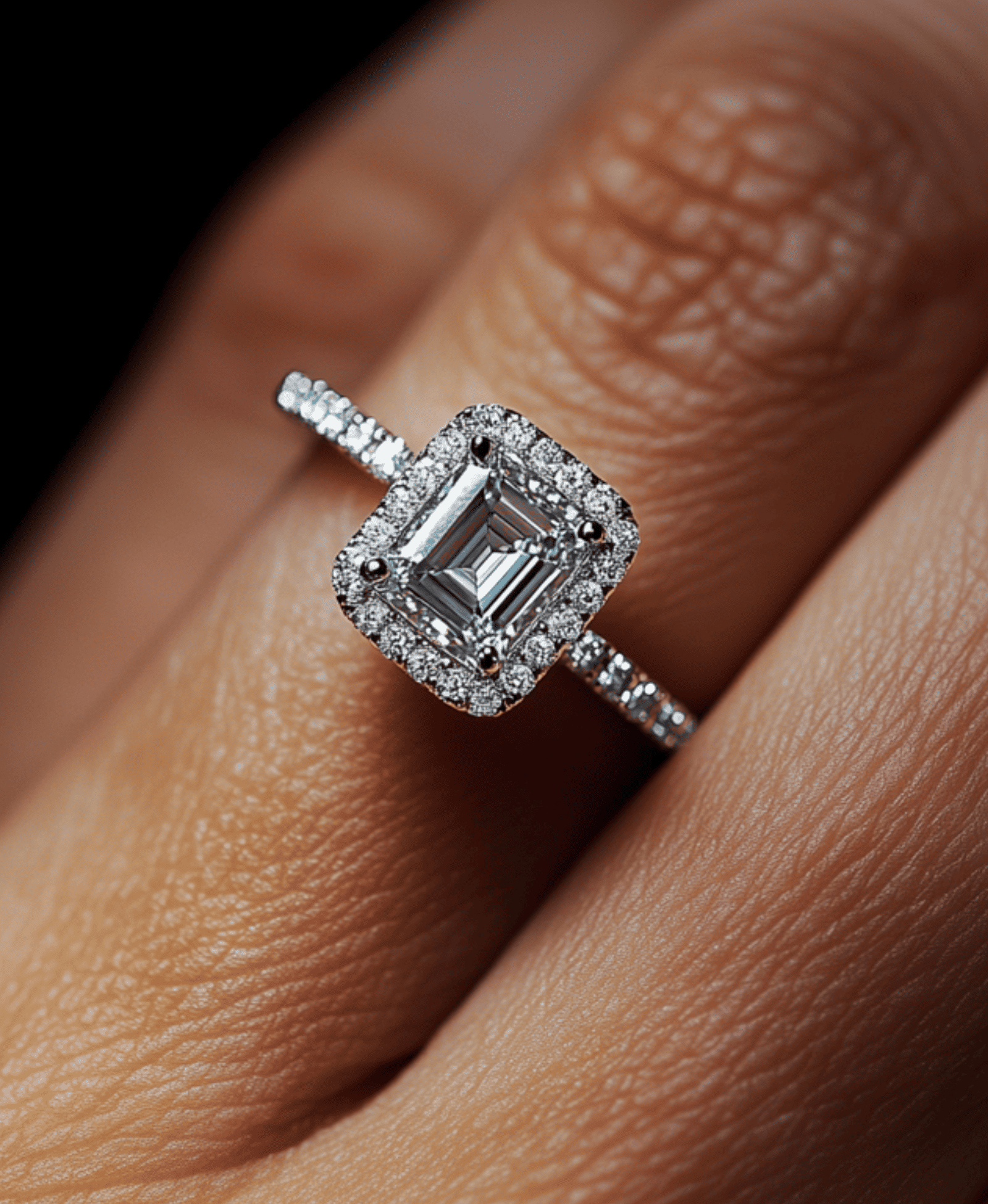
Halo (entourage): a setting in which a central stone is surrounded by a row of diamonds or other gemstones.
F
Facet: a flat, polished surface cut onto a gemstone to control how it reflects and refracts light.
Fancy Color: a classification used for diamonds with a sufficiently pronounced natural color. Intensity can be described by terms such as Fancy Light, Fancy, Fancy Intense, or Fancy Vivid.
Fire: Colored flashes visible in a faceted gemstone, produced by the dispersion of light.
FL / IF: diamond clarity grades. FL (Flawless) indicates the absence of inclusions and surface blemishes observable at 10× magnification according to laboratory criteria; IF (Internally Flawless) indicates the absence of internal inclusions observable at 10×.
Fluorescence: The emission of visible light by a gemstone when exposed to certain ultraviolet rays. On a diamond report, its intensity may be indicated from None to Very Strong, depending on the laboratory.
G
Gemstone: a natural or—when clearly designated as such—synthetic material used in jewelry for its aesthetic and physical qualities.
Gemology: the science devoted to the identification and study of gemstones, their properties, treatments, and, in some cases, their origin.
Gemologist: a professional trained in the identification and analysis of gemstones using observational methods and specialized instruments.
GIA: Gemological Institute of America, a gemological research and teaching organization and internationally recognized laboratory, responsible for the modern 4Cs system.
Garnet: a family of minerals including several gem varieties, in colors ranging from red to green, orange, and purple.
H
HRD Antwerp: a diamond laboratory and institution based in Antwerp, issuing grading reports for diamonds.
Emerald oiling: a traditional treatment consisting of introducing an oil, often colorless, into surface-reaching fissures to reduce their visibility. The degree of filling is an important element of the appraisal.
I
Imitation / Simulant: a natural or artificial material that visually resembles a gemstone without having the same composition and/or structure. Cubic zirconia, for example, is a diamond simulant.
Inclusion: an internal characteristic of a gemstone: a crystal, fissure, cavity, cloud, or other feature. Inclusions can aid in identification and influence clarity.
Refractive index: a measure of how light slows down and changes direction when passing through a material. This is an important property for gemological identification.
Iridescence: a play of colors produced by light interference or diffraction in certain gemstone materials.
J
Jade: a gemological name covering primarily two distinct materials, jadeite and nephrite.
Jet: a black organic gemstone material derived from fossilized lignite wood, historically used in jewelry.
Jasper: an opaque variety of microcrystalline silica, often colored or patterned by mineral inclusions.
K
Kunzite: a pink to purplish-pink variety of spodumene. Its color can be sensitive to prolonged exposure to intense light.
L
Labradorite: a feldspar known for its colorful reflections, called labradorescence.
Gemological laboratory: a specialized structure that analyzes gemstones using scientific instruments and methods and can issue identification or grading reports.
Lapis lazuli: a blue ornamental rock composed mainly of lazurite, often accompanied by calcite and pyrite.
LFG: Laboratoire Français de Gemmologie, a Parisian laboratory founded in 1929, specializing in the analysis of diamonds, colored stones, pearls, and other gemstone materials.
10× Loupe: the reference magnifying glass used notably for examining diamond clarity. Clarity grades are determined under standardized conditions by qualified observers.
M
Twin (crystal): an association of two or more crystalline parts oriented according to a specific symmetry relationship. Twins can be visible as internal characteristics of some gemstones.
Marquise / Navette (cut): an elongated cut with two pointed ends, prized for its slenderizing effect.
Resizing: modifying the circumference of a ring to fit a finger. Its feasibility depends on the construction of the piece, the metal, the stones, and the possible presence of hallmarks or signatures.
Moissanite: silicon carbide used in jewelry, most often produced in a lab. Its luster and high dispersion may resemble a diamond, but its gemological properties are different.
Morganite: a pink to peach variety of beryl, belonging to the same mineral family as emerald and aquamarine.
N
Mother-of-pearl: an iridescent material produced by certain mollusks, constituting the main layer of pearlescent pearls.
Natural (rough remnant): a small portion of the original crystal surface left on a cut diamond, often near the girdle.
Cloud: a group of very small inclusions close together, sometimes giving a slightly hazy appearance within a gemstone.
O
Onyx: a variety of chalcedony generally characterized by parallel bands. In jewelry, the term commonly refers to black chalcedony, often treated to achieve a uniform color.
Opal: a gemstone material consisting of hydrated silica. Some opals exhibit a characteristic spectral play of color.
Oval (cut): an elliptical cut derived from the brilliant, used for diamonds and many colored stones.
P
Padparadscha: a designation applied to certain sapphires displaying a delicate combination of pink and orange. Precise acceptance criteria can vary by laboratory.
Paraiba (tourmaline): a trade name associated with copper-bearing tourmalines of particularly vivid blue to green hues. Geographical origin and composition must be distinguished.
Pavé: a setting technique where many small stones are placed very close together to visually cover the surface of the metal.
Pavilion: the lower part of a faceted gemstone, located below the girdle. Its angles and depth strongly influence light return.
Cultured pearl: a pearl formed in a mollusk following human intervention intended to initiate its formation. It remains a biological product, unlike a pearl imitation.
Natural pearl: a pearl formed without human intervention in a mollusk. Fine natural pearls are rare on the market today.
Peridot: a gem variety of olivine, generally yellowish-green to olive-green in color.
Colored stone: a common term referring to gemstones other than colorless diamonds, notably rubies, sapphires, emeralds, spinels, tourmalines, and garnets.
Moonstone: a feldspar that generally exhibits a white or bluish adularescence, creating the impression of light floating beneath the surface.
Semi-precious stone: a commercial term commonly used for many gemstones other than diamond, ruby, sapphire, and emerald. It does not constitute a scientific quality category.
Hallmark: a mark stamped on a piece of jewelry that can provide information such as the precious metal purity, the manufacturer, or the person responsible for the item, depending on the system used.
Maker's mark: a hallmark used to identify a manufacturer or workshop according to the rules of the country concerned. In France, its shape and registration are regulated.
Pear (cut): a teardrop-shaped cut combining a rounded end with a point.
Polish: the quality of the finish of a gemstone's facets. For diamonds, polish is one of the characteristics evaluated on grading reports.
Diamond clarity: an assessment of the presence, size, number, position, and nature of inclusions and external characteristics observed under standardized conditions.
Q
Quartz: a very common mineral family that includes amethyst, citrine, and rose quartz.
Rose quartz: a pink variety of quartz, generally translucent, whose color is related to structural defects and/or very fine inclusions.
R
Radiant (cut): a square or rectangular cut with cropped corners that combines a geometric silhouette with brilliant-style faceting.
Grading report: a laboratory report describing and classifying certain characteristics of a gemstone, notably the 4Cs for many diamonds. It should not be confused with a valuation.
Refractometer: a gemological instrument used to measure the refractive index of many gemstones and assist in their identification.
Diamond rivière: a necklace or bracelet composed of a continuous succession of diamonds, often of graduated or regular dimensions.
Girdle: the peripheral edge separating the crown from the pavilion of a faceted gemstone.
Round brilliant (cut): the reference circular cut for diamonds, generally composed of 57 facets, or 58 when a culet facet is present.
Ruby: the red variety of corundum. Its color is primarily linked to chromium. Color, origin, treatments, and overall quality strongly influence its value.
S
Sapphire: a gem variety of corundum other than ruby. Blue is the most well-known color, but there are also pink, yellow, green, purple, orange, and colorless sapphires.
Unheated sapphire: a sapphire for which a laboratory has not detected any indication of heat treatment. While this characteristic may be sought after, the value always depends on all of the stone's qualities.
Bezel setting: a setting in which a band of metal surrounds all or part of the stone's outline to hold it in place.
Bead setting: a setting where small beads of metal are raised and pushed over the stones, often used for pavé.
Prong setting: a setting in which several metal prongs hold the stone while allowing light to enter freely.
Invisible setting: a technique where stones are held without visible metal between them, thanks to grooves and a rail system beneath the gems.
Setting: the set of techniques used to fix one or more stones onto a mount.
SI: clarity grades SI1 and SI2 (Slightly Included), inclusions perceptible at ×10 magnification to a trained observer. Their visibility to the naked eye varies depending on the stone and the nature of the inclusions.
Simulant: See Imitation; a material that resembles a gemstone without possessing its composition and structure.
Solitaire: a piece of jewelry, notably a ring, that showcases a single main stone, often a diamond.
Spinel: a gemstone crystallizing in the cubic system, available in many colors. Red spinels have historically been confused with certain rubies.
Symmetry: the quality of the alignment and regularity of the facets of a cut stone. For diamonds, it is evaluated separately from the polish.
Synthetic (gemstone): a gemstone produced by human means that essentially possesses the same chemical composition and crystal structure as its natural equivalent. Its synthetic origin must be disclosed.
T
Table: the large facet located at the top of many faceted gemstones. Its proportions contribute to the stone's appearance and light performance.
Cut: the way a gemstone is shaped and polished. For a round brilliant diamond, cut quality is one of the 4Cs and plays a major role in brilliance.
Old cut: a term grouping several historical diamond cut styles, notably Old Mine and Old European, generally characterized by less standardized faceting than modern cuts, a often deep pavilion, and sometimes an open culet.
Emerald cut: a rectangular step cut with cropped corners. Its mirror effect particularly highlights the stone's transparency, color, and inclusions.
Princess cut: a square or slightly rectangular cut, generally with brilliant faceting and uncropped corners.
Rose cut: a historical cut featuring a generally flat bottom and a domed top composed of triangular facets, widely used before the development of modern brilliant cuts.
Transition cut: a diamond cut style developed between old European cuts and the modern brilliant, mainly during the first half of the 20th century.
Tanzanite: a blue to violet-blue variety of zoisite, commercially sourced from Tanzania and often heated to develop its color.
Topaz: a gemstone available in several colors, notably colorless, blue, yellow, orange, and pink. Some commercial colors may result from treatments.
Tourmaline: a family of gemstones offering a very wide diversity of colors, including pink, green, and copper-bearing tourmalines known as Paraíba.
Treatment: an intervention applied to a gemstone in order to modify its appearance or certain characteristics. Significant treatments must be properly disclosed at the time of sale.
Heat treatment: the controlled heating of a gemstone to modify its color and/or clarity. It is common for certain stones, notably many rubies and sapphires.
Trillion / Trilliant (cut): a triangular cut, with straight or slightly curved sides, used as a center stone or side stone.
Triplet: an assembled stone composed of three layers. Some opal triplets combine a thin layer of opal with a dark backing and a transparent protective cap.
V
VS: clarity grades VS1 and VS2 (Very Slightly Included), minor inclusions observable at ×10, ranging from difficult to relatively easy to see for a trained observer.
VVS: clarity grades VVS1 and VVS2 (Very Very Slightly Included), tiny inclusions that are very difficult to difficult to observe at ×10 for a trained observer.
Z
Zircon: a natural zirconium silicate gemstone, known for its brilliance and strong dispersion. It should not be confused with cubic zirconia.
Cubic Zirconia (CZ): a synthetic material used as a diamond simulant. It is chemically and physically distinct from natural or lab-grown diamonds.
About this glossary
This glossary has been designed as an accessible reference tool: it prioritizes terms
actually useful in jewelry and applied gemology, rather than general geological notions
with no direct link to the experience of buying, selling, or appraising a piece of jewelry.
For a significant stone, a diamond accompanied by a report, an antique piece, or a signed jewel, reading a term never replaces the examination of the piece as a whole.