
The 4Cs of Diamonds
The result of a collaboration between De Beers and the GIA (Gemological Institute of America) in 1940, the 4Cs of diamond quality are still the benchmark for assessing the quality of this precious stone. Indeed, although diamonds are the "ne plus ultra" of precious stones, not all diamonds are of equal value. Therefore, it is necessary to have universal criteria to determine the exceptional qualities of a diamond.
What are the 4Cs of diamond quality?
The story of the 4Cs began in the early 20th century in the United States. This is where Robert M. Shipley, a former jeweler, decided to establish the GIA with the aim of professionalizing the jewelry industry. Subsequently, the teaching provided to future jewelers by this institution, primarily based on the 4Cs, cemented the popularity of these criteria for jewelers worldwide who sell diamond jewelry.
The term 4Cs of diamond quality comes from the first letters of the English names of the 4 reference criteria for determining a diamond's value. These are:
- Cut
- Color
- Clarity
- Carat
These evaluation criteria are primarily intended for white diamonds. Let's now see how all these elements are measured.
The 4Cs of diamond quality: Cut
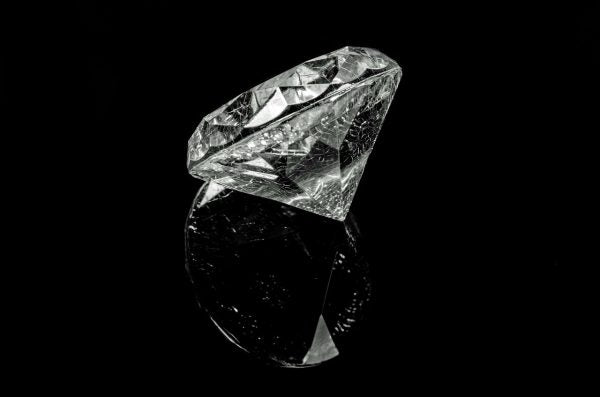
The cut of a diamond has a significant impact on its sparkle and brilliance. That's why the meticulousness with which this process is executed greatly influences the value of the stone once cut. In fact, a diamond with perfectly symmetrical and aligned facets allows for better light diffusion through the stone, hence its sumptuous brilliance.
Unlike the other 4Cs of diamond quality, the cut (as well as the carat weight, for that matter) of a diamond is not a work of nature and depends on human talent. A moderately clear diamond that is well cut (to ideal proportions) can appear more brilliant. The opposite is also true, as a gem can be clear and colorless, yet also dull and lifeless if it is not well cut.
Therefore, believing that a diamond with excellent clarity and a beautiful color is automatically sparkling is a pure illusion. Concretely, while these two criteria add greater value to the diamond, it is truly its cut that gives it its most beautiful brilliance, and encourages customers to buy a particular diamond jewel to celebrate a special occasion.
It must be noted that the lower a diamond's carat count, the more it shines. But it is also true that a large diamond is more expensive, and therefore harder to sell. These are the reasons why many diamantaires decide to cut larger diamonds into several smaller stones precisely to achieve extraordinary brilliance and sell their stock more quickly. And it also allows them to obtain an excellent GIA grading certificate for the diamonds.
How to judge a diamond's brilliance?
In addition to an expert's eye, devices can determine a diamond's brilliance, including the Ideal-Scope. Invented by Garry Holloway, this device is a brightly colored reflector with an observation hole and a lens. In other words, it reflects light onto the diamond. If red areas appear, it means the gem has a high degree of brilliance. However, if the light reveals white areas, it suggests that it needs work, particularly by giving it a better cut.
In short, before buying a diamond, it is necessary to examine it carefully (with an Ideal-Scope, for example) to determine its brilliance, and not rely solely on the GIA certificate.
The 4Cs of diamond quality: Color
First, it must be stated that diamonds are not always colorless. Indeed, this precious stone comes in various natural colors, such as pink and blue.
During its formation, the diamond absorbs gases that subsequently give it a certain hue. And it is depending on the quantity of absorbed gas that the diamond ends up with a hue that is more or less yellow.
Once cut and ready for market, diamonds are classified according to their natural color. For international standardization, the GIA or Gemological Institute of America established a color scale from D to Z. D represents an exceptional colorless "white" diamond. As for Z, it defines a slightly yellow stone color.
It should be noted, however, that slightly tinted diamonds should not be confused with yellow diamonds (which we saw above) and other fine stones with a natural yellow color like sunstone or yellow beryl. In fact, these stones are classified on a color scale totally different from that of white diamonds.

Tips and tricks for buying a diamond based on its color
Do you want to invest in a beautiful, flawless diamond with a hue invisible to the naked eye? But you don't know how to go about it. Don't worry, we're giving you all the tips to make the most of your investment.
- Since not all of us are experts in detecting diamond hues, it is preferable to buy diamonds graded between G and J on the color scale. This will cost you less than a diamond whose color is between D and F.
- Similarly, know that the larger the diamond, the more it reflects light. Therefore, it is also easier to differentiate its color. So, if your budget allows, opt for a diamond with a higher carat weight. Indeed, this allows for better color differentiation.
- A yellow gold piece of jewelry set with one or more diamonds reflects yellow light through the diamond. Thus, a diamond with good whiteness can still be tinged with yellow. So expect a colored diamond if it is mounted on a yellow gold piece of jewelry. If you want your diamond to be colorless, choose jewelry made of white gold, rose gold, silver, or platinum.
- If you want your diamond to be as brilliant as possible, choose one with a high carat weight and a slightly tinted color. This way, your diamond will have more value because its carat count is higher.
- Do not rely on the diamond ranges established by most jewelers. It is always advisable to buy a diamond with a certificate indicating its precise color grade.
4Cs: Diamond clarity
Clarity is a diamond quality linked to the existence and visual appearance of certain elements that compose it. In other words, its inclusions and blemishes. It should also be noted that the prices of diamond jewelry vary depending on this factor. Hence the importance of taking it into account if you plan to invest in a diamond ring, a diamond necklace, etc.
Terms relating to diamond clarity
Of course, experts use specific terminology to describe internal characteristics and surface blemishes. Here they are.
Internal characteristics of the diamond
Regarding inclusions, here are some terms to remember:
- Cloud: A nebulous or milky area caused by fine crystal inclusions.
- Feather: A fracture caused by cleavage, generally white and feather-shaped.
- Cavity: The presence of an angular opening on the diamond's surface.
- Knot: A transparent crystal included in the diamond that extends to the diamond's surface after cutting.
- Pinpoint: A tiny crystal that looks like a small dot or speck under 10x magnification.
- Needle: A fine, long inclusion resembling a small rod under 10x magnification.
- Internal graining: An inclusion due to internal structural distortion of the diamond or an internal sign of irregular crystal growth.
- Bearding: An inclusion similar to feathers that appears on the girdle as a result of the diamond's bruting.
- Twinning wisp: The presence of a flat ribbon of small crystals caused by crystal distortion during growth. It generally takes the form of an undulation or a wispy line.
Diamond surface blemishes
As for flaws, the following terms should be taken into account:
- Polish line: A small parallel line left by the diamond's polishing.
- Surface graining: An internal growth line that appears on the diamond's surface.
- Natural: The presence of a small unpolished part on the diamond's surface after cutting. Generally, it appears at the girdle of the stone.
- Scratch: A fine superficial line present on the diamond's surface.
- Nick: A slight notch or chip located near the girdle or a facet edge.
- Pit: A tiny cavity found on the surface of a cut diamond.
- Chip: The presence of a superficial opening resulting from cutting or damage to the diamond's surface.
- Abrasion: A scratch or small mark that appears on the facet edges.
- Extra facet: One or more additional facets that do not meet the standard for the considered diamond cut.

Diamond Clarity Scale
The Gemological Institute of America (GIA) established the standard for diamond clarity grading. This international scale includes various codes composed of letters and numbers. It goes without saying that to define the degree of purity or clarity of a diamond, 4C diamond experts observe the stone with a 10x magnification loupe.
Some inclusions are visible to the naked eye, in which case the diamond is described as "piqué (P) or imperfect (I)". However, more often than not, inclusions are difficult to locate with the naked eye. Indeed, this precious stone has a very high refractive index of light. It also has a great power of reflection.
Discover below the degrees of diamond clarity.
First, there is the rarest of diamond finds: FL (Flawless). Indeed, no internal inclusions and no surface blemishes of any kind are observed, even with the use of a qualified loupe using 10x magnification.
Secondly, there is the IF (Internally Flawless), which means "internally pure" or "loupe-clean". In this case, internal inclusions are non-existent. However, imperfections are still visible with a loupe (10x magnification).
Then come the VVS1-VVS2 (Very Very Small inclusions). Very, very small inclusions are present, but are difficult to perceive with a loupe.
After that, we can mention the VS1-VS2 (Very Small inclusions) which are characterized by the presence of minor inclusions (visible with a 10x magnification loupe) in the diamond. However, this precious stone is still of high quality.
As for SI1-SI2-SI3 (Small Inclusions), these small internal inclusions and external imperfections are easily detectable with a loupe. Nevertheless, they are generally imperceptible to the naked eye.
Finally, there are the I1-I2-I3 (Imperfect) which are obviously distinguished by the apparent visibility of inclusions and imperfections to the naked eye. These also slightly affect the brilliance of the diamond.
Choosing your diamond based on its clarity
Of course, buying a diamond depends primarily on your needs, preferences, and budget. In most cases, you will likely find diamonds with small inclusions and imperfections. Also, it's important to know that the fewer inclusions a diamond has and the less visible they are, the higher its clarity grade.
Furthermore, to make the most of your budget, prefer an "eye-clean" diamond. In other words, a diamond graded VS1 or higher, where inclusions and imperfections are only perceptible with a 10x magnification loupe. After purchase, you should also ensure that the seller provides you with a GIA-approved certificate guaranteeing the diamond's quality.
4Cs of diamond quality: Weight
A diamond's weight is measured in carats, a unit of measurement equivalent to 200 milligrams. According to the 4Cs of diamonds, a diamond's weight directly depends on its size. In other words, like any precious object, its size greatly contributes to its value. This is why, for equal quality, a given diamond's weight can increase its value compared to another stone.
Carat: Definition and origin
You are probably wondering how the carat is defined. Nothing could be simpler! The carat is a unit of measurement used in gemology to define the weight of precious stones, including diamonds. Thus, in jewelry, one carat corresponds to 0.20 g (or 200 mg). For the record, it was in 1907 that experts defined the metric carat, during the 4th General Conference on Weights and Measures (CGPM).
As for the origin of the word, it comes from the term "Qirat" or "kuara" which refers to carob pods. Indeed, the seeds of the carob tree (found in Mediterranean regions) have a very regular weight. As a result, they were long used as a mass standard during Antiquity to weigh gems.
Diamond carat weight: How to evaluate it?
Obviously, it is perfectly possible to estimate the weight of a diamond based on its size (in mm). Otherwise, simply measure its mass directly using a specific balance (carat balance). However, for an accurate measurement, it is advisable to perform the weighing in a closed place, away from:
- drafts
- vibrations
- heat sources
Note that the stone must be clean at the time of weighing.
Diamond weight expressed in points
Because a diamond's weight is measured to the hundredth of a carat, the carat is divided into 100 points. Most jewelers work with diamonds weighing less than one carat. Likewise, individuals generally opt for smaller precious stones. In fact, you know that a 1-carat gem is relatively large and expensive, hence the interest in small diamonds.
One point is equivalent to one-hundredth of a carat. Thus, a 60-point diamond corresponds to a 0.6-carat diamond. However, for 25 points, we speak of 1/4 of a carat.
Good to know: the cutting and regularity characteristics of a diamond also allow its weight to be assessed. To do this, it is important to measure the stone's dimensions.
Our tips for choosing a diamond based on its weight
To find the ideal stone to set in a diamond piece of jewelry, it is important to take into account the 4Cs, including the carat. Nevertheless, it is essential to consider the cut and the carat together. Indeed, a poor cut quality can hinder a diamond even if it has a larger carat weight. Conversely, a smaller diamond with an excellent cut quality can appear significantly larger.
Of course, it is preferable to opt for a diamond weighing less than one carat (1/4 carat, half-carat, etc.). This will certainly allow you to save money while still indulging yourself.
4C Diamond: how to choose your jewelry well
Depending on your tastes and budget, the 4Cs will be of great help when buying a diamond. Indeed, these criteria are the best way to effectively estimate the price and quality of a diamond. Moreover, there is no better way to enhance one's look and outfit at a social event or special occasion than with diamond jewelry. Diamond necklaces, diamond-set rings, diamond earrings..., there are options for both men and women. And for more authenticity, visit experts in antique jewelry.
It should also be noted that the big names in high jewelry take the 4Cs of diamonds into account when choosing the diamonds they use for their designs. Luxury jewelry from De Beers, Cartier, Chopard, Poiray... certainly speaks for itself.