



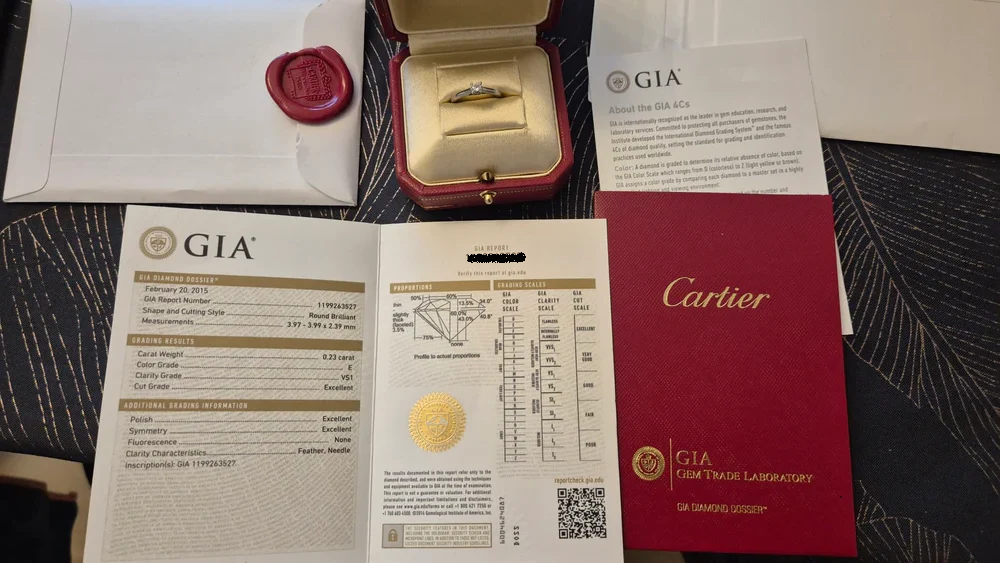
GIA, HRD, LFG: what is the difference between these 3 diamond certificates?
When buying or selling a diamond, the stone is often accompanied by a document commonly known as a diamond certificate.
The more precise term is actually a gemological report or grading report. This document, issued by a gemological laboratory, describes the main characteristics of the diamond at the time of its examination.

Among the laboratories regularly encountered in the French, European, and international markets are the GIA (Gemological Institute of America), the HRD Antwerp, and the LFG (Laboratoire Français de Gemmologie).
What are their differences? Is a GIA certificate preferable to an HRD or an LFG? Can their grades be directly compared? And does a diamond need to be unset to be properly analyzed?
At Miller, we daily appraise second-hand jewelry and diamonds. Here are the essential points to know.
What is a diamond certificate?
A diamond certificate is primarily a gemological report.
When a diamond is examined under conditions allowing for full grading, the laboratory can determine its main characteristics, notably the famous 4Cs of diamond:
- Carat: the diamond's weight;
- Color: its color;
- Clarity: its purity;
- Cut: its cut quality, where this grade is applicable.
The report can also provide information on the diamond's dimensions, proportions, fluorescence, polish, symmetry, the nature and position of its inclusions, and the potential presence of certain treatments.
It is nevertheless essential to understand that a gemological report is not a financial estimate of the diamond.
It describes the stone according to gemological criteria. Its market value then depends on these characteristics, but also on many other factors.
In the case of a signed piece of jewelry, the value also depends on the House, the model, the era, the rarity, the condition, and the desirability of the jewelry on the second-hand market.
Why must a diamond be unset for precise grading?
This is an essential point, and sometimes misunderstood.
To carry out a complete and precise grading of a diamond, the stone must generally be examined unset, i.e., unmounted.
Why?
Because a setting can hinder or disturb the observation of several essential characteristics of the diamond.

Why must a diamond be unset for precise grading?
This is an essential point, and sometimes misunderstood.
To carry out a complete and precise grading of a diamond, the stone must generally be examined unset, i.e., unmounted.
Why?
Because a setting can hinder or disturb the observation of several essential characteristics of the diamond.
Color
The metal surrounding the stone can influence the perception of its color.
Yellow gold, rose gold, platinum, or white gold can visually alter how the diamond's hue is perceived.
To assign an accurate color grade under the conditions specified by laboratories, it is therefore necessary to be able to properly observe the stone independently of its setting.
Clarity
The prongs, setting, or certain parts of the mounting can conceal inclusions.
An inclusion located under a prong, for example, can be difficult, if not impossible, to examine properly as long as the diamond is mounted.
Unsetting therefore allows the stone to be observed from all angles.
Weight
When a diamond is mounted, its weight cannot be determined directly with the same precision as a loose stone that can be weighed.
It is possible to estimate the weight from the dimensions of a mounted stone, but this does not replace an actual weighing of the unset diamond.
However, a few hundredths of a carat can impact the value of a diamond, particularly when it falls around certain significant weight thresholds.

Proportions and general examination of the stone
Unsetting also provides free access to the entire diamond to examine its proportions, girdle, culet, facets, and various internal and external characteristics.
It also facilitates the detection of certain treatments.
To obtain a complete and precise laboratory grading, the diamond must therefore be examined unmounted when required by the laboratory protocol.
Can a diamond still be appraised when it is mounted?
Yes, but a distinction must be made between jewelry appraisal and full diamond grading in a laboratory.
An experienced gemologist can examine a mounted diamond and obtain a lot of information allowing them to appraise a piece of jewelry and estimate its value.
This is indeed part of the daily work of a professional in antique and second-hand jewelry: it is obviously not necessary to systematically unmount all diamonds from all pieces of jewelry presented for an initial appraisal.
However, certain characteristics must then be considered as estimates, as the mounting necessarily limits the examination.
When very precise knowledge of the diamond's characteristics is necessary—especially to establish a complete grading report—unsetting becomes essential.
Therefore, an important distinction must be remembered:
a diamond can be appraised when mounted, but complete and precise grading generally requires it to be unset.
The GIA certificate: an international benchmark
Founded in 1931 in the United States, the Gemological Institute of America (GIA) is one of the most well-known and recognized gemological laboratories in the world.
The GIA has played a major role in the development and standardization of the 4Cs, now used internationally to describe diamonds.

How does the GIA grade diamonds?
For the color of natural diamonds covered by its D-Z scale, the GIA uses a grading system ranging from:
D to Z
D corresponding to the highest level on the scale in terms of absence of color.
For clarity, the scale includes:
FL – IF – VVS1 – VVS2 – VS1 – VS2 – SI1 – SI2 – I1 – I2 – I3
The report may also mention the diamond's fluorescence, polish, symmetry, and proportions.
Regarding the Cut Grade, it should be precise: the GIA's overall cut grade specifically applies to standard round brilliant diamonds meeting the laboratory's criteria. It should not be generalized in the same way to all diamond shapes.
Does the GIA certify mounted diamonds?
For its Diamond Grading Report, the GIA requires that the diamond be presented unmounted.
This requirement allows for proper evaluation of color and clarity, determination of the exact weight of the stone, and performance of all necessary observations under suitable conditions.
The GIA also offers other types of services that may apply to certain mounted jewelry or stones. However, these should not be confused with the complete grading of a loose diamond.
Why is the GIA so sought after?
Its international recognition notably facilitates the comparison and commercialization of diamonds in different markets.
For a significant diamond intended for an international clientele, the presence of a GIA report can therefore be a particularly appreciated element.
This does not mean that a diamond accompanied by a report from another recognized laboratory is necessarily of lower quality.
The laboratory describes the stone: it does not determine its beauty.
The HRD Antwerp certificate: a historical European benchmark
HRD Antwerp is historically associated with Antwerp, one of the world's leading diamond trading centers.
Its reports are particularly prevalent in the European market.
HRD examines various criteria for characterizing diamonds, including their weight, color, clarity, and various characteristics related to their cut.

What is the difference between HRD and GIA?
Both laboratories pursue the same general objective of diamond description and grading, but their nomenclatures are not entirely identical.
HRD notably uses the grade:
LC – Loupe Clean
at the top of its clarity scale, followed notably by:
VVS1 – VVS2 – VS1 – VS2 – SI1 – SI2 – P1 – P2 – P3.
The GIA, for its part, uses the grades FL (Flawless) and IF (Internally Flawless) at the top of its scale.
It would therefore be incorrect to establish an automatic equivalence between all the grades of the two laboratories.
Is an HRD diamond worse than a GIA diamond?
No.
A diamond is not better or worse because it has a GIA, HRD, or LFG report.
The quality belongs to the stone, not to the paper that accompanies it.
It can happen that the same diamond examined by two laboratories obtains a different assessment on certain criteria, especially when a characteristic is on the borderline between two grades.
However, this does not allow for establishing a general rule such as:
"an HRD VS2 corresponds to a GIA VS1"
or vice versa.
There is no systematic conversion table between the different laboratories.
The LFG: the French Gemological Laboratory
Founded in 1929, the Laboratoire Français de Gemmologie (LFG) is a historic French gemological laboratory.
Its expertise is not limited to diamonds. The LFG also analyzes colored stones, pearls, and various gems used in jewelry.

It naturally holds an important place in the French market.
Does the LFG grade mounted diamonds?
An important clarification is needed here.
The LFG can offer analyses of stones and jewelry. However, this does not mean that a mounted diamond can receive exactly the same complete grading as a loose diamond.
For certain essential characteristics of a diamond, and particularly for a precise grading of its color and clarity, the diamond must be isolated and unmounted.
Therefore, it is incorrect to present the possibility of examining a mounted stone as an advantage that allows the same grading to be obtained without unmounting it.
The analysis of mounted jewelry and the complete grading of a loose diamond are two different services.
GIA, HRD or LFG: which is the best certificate?
It would be too simplistic to establish an absolute ranking between these three laboratories.
GIA
The GIA enjoys particularly significant international recognition, and its reports are widely used in the global diamond market.
HRD Antwerp
HRD is a historic player in the Antwerp diamond district, and its reports are commonly found in the European market.
LFG
The LFG is a historic French gemmological laboratory, particularly prominent in the world of gemstones and jewelry in France.
For a buyer, the important thing is first to understand which report was established, under what conditions, and what information it contains.
Comparative table GIA, HRD and LFG
| GIA | HRD | LFG | |
|---|---|---|---|
| Country | United States | Belgium | France |
| Year founded | 1931 | 1973 | 1929 |
| Color scale | D to Z | D to Z | D to Z |
| Maximum clarity terminology | IF (Internally Flawless) | Loupe Clean (LC) | IF |
| International recognition | Worldwide | Strong in Europe | France and French-speaking Europe |
| Distinctive strong point | Universal global standard | Renowned Antwerp rigor | Ethics and stone traceability |
Can a GIA, HRD, and LFG diamond be directly compared?
One must be cautious.
Two diamonds displaying the same weight, color, and clarity on their reports are not necessarily visually identical.
The beauty of a diamond also depends on many other elements: its proportions, the quality of its cut, its fluorescence, the nature and position of its inclusions, its transparency, and, more generally, its visual appearance to the eye.
Furthermore, when a stone is on the borderline between two grades, a difference in assessment may exist.
This is why, at Miller, we do not seek to perform an automatic conversion between GIA, HRD, and LFG grades.
We first look at the diamond itself.

What about an antique diamond or vintage jewelry?
The issue of unmounting is particularly important in our profession.
Many antique diamonds have never been accompanied by a gemmological report. They were sometimes cut and mounted several decades before the generalization of modern reports.
This obviously does not mean that they are of lower quality or lesser value.
During an initial appraisal of antique or signed jewelry, it is not always desirable to unmount the diamond immediately.
The setting itself may be old, fragile, or of historical interest. Unmounting also represents an intervention on the jewelry that must be justified.
The gemmologist therefore begins by examining the jewelry as a whole.
When the value or characteristics of the stone warrant a more in-depth analysis, the diamond can then be entrusted to a workshop to be unmounted under good conditions, then sent to a laboratory for a precise report.
Once the analysis is completed, it can be remounted by a professional.
Is a certificate sufficient to estimate the value of a diamond?
No.
The gemmological report provides essential data on the diamond, but it does not give its financial value.
The estimation requires putting these characteristics into perspective with the market.
For a second-hand piece of jewelry, the following must also be considered:
- the House;
- the model;
- the era;
- rarity;
- condition;
- manufacturing quality;
- the presence of original elements;
- and the desirability of the jewelry on the market.
A diamond with excellent gemmological characteristics does not automatically imply that a piece of jewelry has a high value, and vice versa.
Gemmological Report and Kimberley Process: beware of confusion
The Kimberley Process and the gemmological report of a diamond are two different subjects.
The Kimberley Process concerns the international trade of rough diamonds and aims to combat the trade of conflict diamonds.
A standard gemmological report established on a cut diamond should therefore not be presented as solely guaranteeing the complete geographical and ethical traceability of the stone.
It is important not to confuse gemmological grading and traceability.
Miller's advice
At Miller, we consider the gemmological report to be an extremely valuable tool, but never the sole element for judging or estimating a diamond.
A GIA, HRD, or LFG report provides precise information on the various characteristics of the stone when it has been examined under the required conditions.
But our profession as a leading gemmologist in Paris also involves looking at the stone itself and the jewelry as a whole.
During an appraisal, we can start by examining a diamond while it is mounted. When its characteristics or value require precise grading, unmounting allows for a much more complete and reliable analysis before its potential submission to the laboratory.
Finally, in the case of signed jewelry, the diamond is only part of the story: the House, the model, the era, the craftsmanship, the condition, the rarity, and market demand are also decisive.

In summary
- GIA: a major international reference in the global diamond market.
- HRD Antwerp: a historical European laboratory strongly associated with the Antwerp diamond district.
- LFG: a historical French gemmological laboratory, specializing in the analysis of diamonds and other gemstones.
To obtain a complete and precise grading of a diamond, unmounting is generally essential, particularly to allow for a reliable assessment of color and clarity, to determine its exact weight, and to freely examine the entire stone.
Nevertheless, a mounted diamond can be appraised and subjected to certain analyses. One must simply distinguish this appraisal from a complete grading performed on a loose stone.
And most importantly:
The report describes the diamond. The appraisal allows for an understanding of the stone, the jewelry, and their market value.
FAQ: GIA, HRD, and LFG diamond certificates
Is an LFG certificate internationally recognized?
The LFG is recognized and respected in Europe, particularly in France and French-speaking countries. It is less known than the GIA in the American or Asian markets. For international resale, a GIA or HRD certificate will facilitate procedures and negotiation.
Is GIA mandatory for purchasing an engagement ring?
No. No certificate is legally required to accompany a Cartier diamond ring or one from another house. However, a gemmological report provides valuable transparency on the quality of the stone. GIA, HRD, or LFG are all valid choices depending on the origin of the stone and the target market. The essential thing is to know how to recognize a real diamond and rely on a trusted jeweler.
How much does an HRD or GIA certification cost?
The cost of certification varies depending on the weight of the stone and the chosen laboratory. Expect to pay between 80 and 200 euros for a standard diamond at HRD. The GIA has similar rates, with lead times ranging from a few days to several weeks depending on the service option chosen.
Does a diamond without a certificate have value?
Yes. The absence of a certificate does not call into question the intrinsic value of a diamond. Many antique diamonds, inherited or acquired before the 1990s, have never been certified. A gemmological appraisal can always be performed after purchase. This is particularly common for jewelry passed down through inheritance or acquired on the second-hand market.
Does Miller provide a certificate with the purchase of every diamond jewel?
At Miller, every piece of jewelry comes with complete documentation. For exceptional stones, a laboratory gemmological report is systematically included. For antique jewelry, the house conducts an internal appraisal by its gemmologists before any sale offer. This ensures total transparency for each piece, whether it's a contemporary solitaire or a signed piece of jewelry acquired second-hand.