Jean Dousset, Cartier heir, offers artificial diamond jewelry
Do lab-grown diamonds have a place in high jewelry? This question highlights the growing tension between traditional luxury and modern innovation. While Jean Dousset—the great-great-grandson of Louis Cartier—embraces lab-grown diamonds, Cartier’s parent company, Richemont, remains opposed. For now, the group maintains that synthetic diamonds do not align with the brand's prestigious image.
Cartier cites the lack of heritage in lab-grown diamonds
“The issue with lab-grown diamonds is that they lack a story, even if they share the same molecular structure as those mined from the earth,” stated Cyrille Vigneron, CEO of Cartier, in an interview for the 'State of Fashion Watches and Jewellery' report by Business of Fashion and McKinsey.
“Many clients will always reject lab-grown diamonds because they have lost their uniqueness and the fact that they were created by the Earth millions of years ago,” he added.
Under Vigneron’s leadership, synthetic diamonds are not entirely excluded from Cartier jewelry, particularly for small accent stones. However, the Maison is not ready to fully embrace them. “We make a promise of naturality and traceability to our clients. Ultimately, this could undermine the value placed on diamonds compared to other gemstones,” he noted.

The opposing view of Jean Dousset, descendant of Louis Cartier
Jean Dousset, the great-great-grandson of Louis-François Cartier, who continues the family legacy under his own name, is launching a lab-grown diamond jewelry collection to complement his popular range of natural diamond pieces.
“This is a paradigm shift for the world of diamonds and luxury,” says Dousset. “One of the most common misconceptions consumers have about lab-grown diamonds is that they are 'fake'.”
Dousset’s jewelry journey
It wasn't nepotism that brought Dousset to where he is today, but rather hard work, talent, and vision—much like his illustrious ancestor.
Born in Paris in 1971, Dousset’s career began in 1992 at Chaumet, the official jeweler to Emperor Napoleon on Place Vendôme. He moved to Boucheron in 1996 and then to Van Cleef & Arpels in 1999, eventually relocating to Los Angeles to spearhead the brand's relaunch on Rodeo Drive in 2001.
Taking the entrepreneurial leap in 2005, he founded his Atelier to create custom diamond jewelry that quickly attracted celebrity clients. Dousset is the designer behind the bespoke engagement rings of Eva Longoria, Amy Adams, and Paris Hilton, among others. Following this success, he opened a boutique in West Hollywood in 2010 and launched his online brand.
With the introduction of his lab-grown collection, Oui by Jean Dousset, he is evolving his business to meet modern consumer desires. In doing so, he follows in the footsteps of the Cartier family, whose business survived for over a century thanks to this very ability to adapt.

These stones are real
“I have followed the evolution of lab-grown diamonds with an open mind for many years,” said Dousset. “I’ve seen how important they have become to consumers. The goal of 'Oui' has always been to make high-quality jewelry more accessible without sacrificing quality, personalization, or carat weight.”
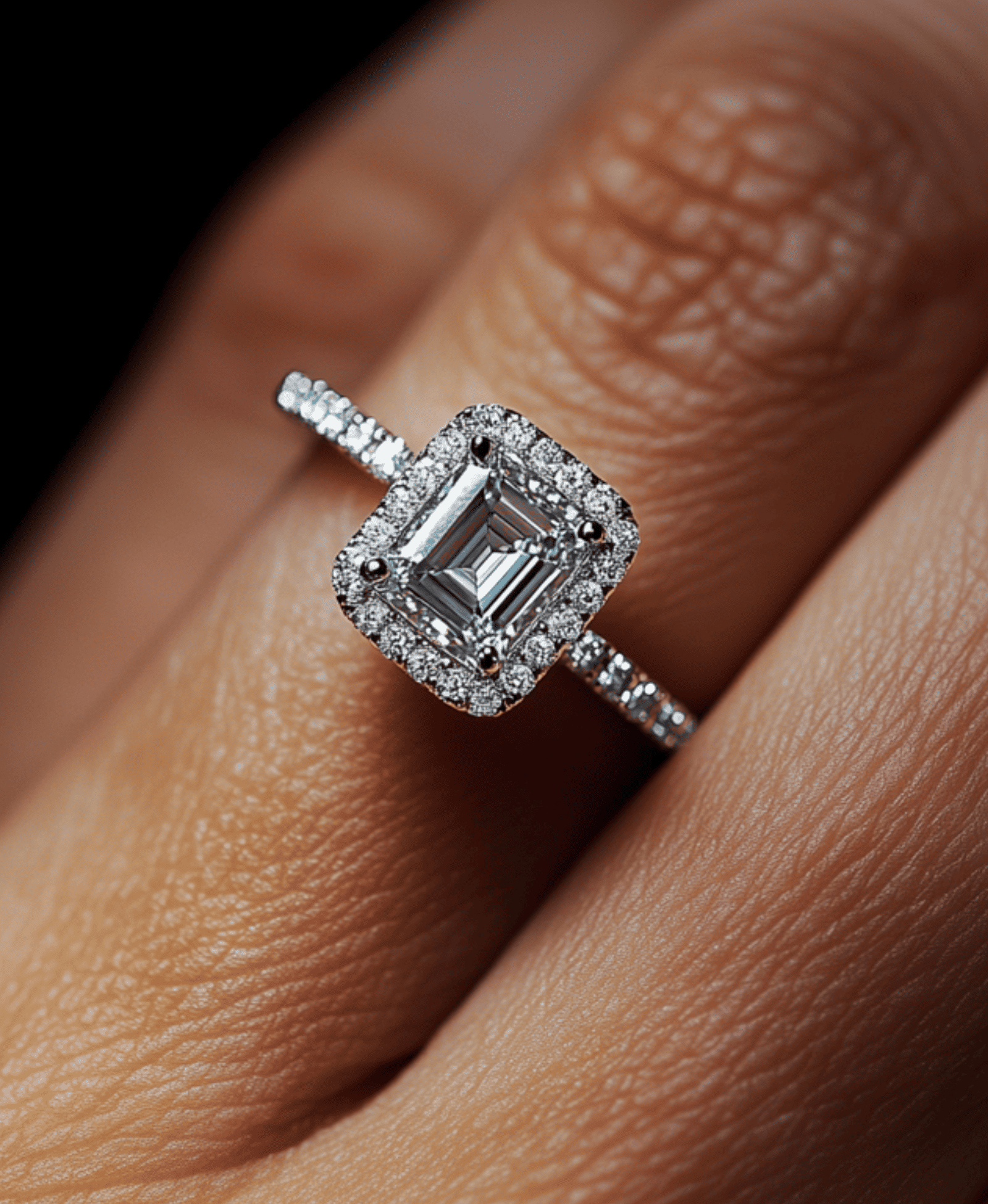
With engagement ring prices starting at $4,300 for a one-carat center stone, it is now possible to purchase designs featuring up to 4 carats.
Furthermore, all Oui diamonds are produced using Chemical Vapor Deposition (CVD), the most efficient method for creating synthetic diamonds. This technology produces stones with all the brilliance and magic of a mined diamond. Each stone is GIA certified as Type IIa, the "most chemically pure" category of diamond. Just like natural diamonds, lab-grown stones must be professionally cut and polished to reveal their unique qualities.
Read also: The 4Cs of Diamonds
High-quality diamond jewelry at a lower price point
“A lab-grown diamond offers the same visual experience without any compromise,” says Dousset, acknowledging that couples are often forced by their budget to sacrifice quality or size. “This is an exciting opportunity for a jeweler. It has been very liberating, both for me and for the client.”
“Lab-grown diamonds allow people to splurge on well-crafted designer rings and brands they couldn't consider before, because so much of their budget was consumed by the high cost of the center stone,” he adds. “A wider group of people can now afford and enjoy the mystique of diamonds.”

Natural or synthetic: giving people the choice
Ultimately, Dousset honors his family tradition while looking toward the future with both his natural diamond jewelry line and the new Oui collection.
“I believe natural and lab-grown diamonds cater to different value systems. They are both excellent choices for different reasons. But in the end, the two options are indistinguishable in terms of brilliance, beauty, and feel,” he concludes. “A diamond is a diamond, and what you decide to buy is entirely a personal choice.”